

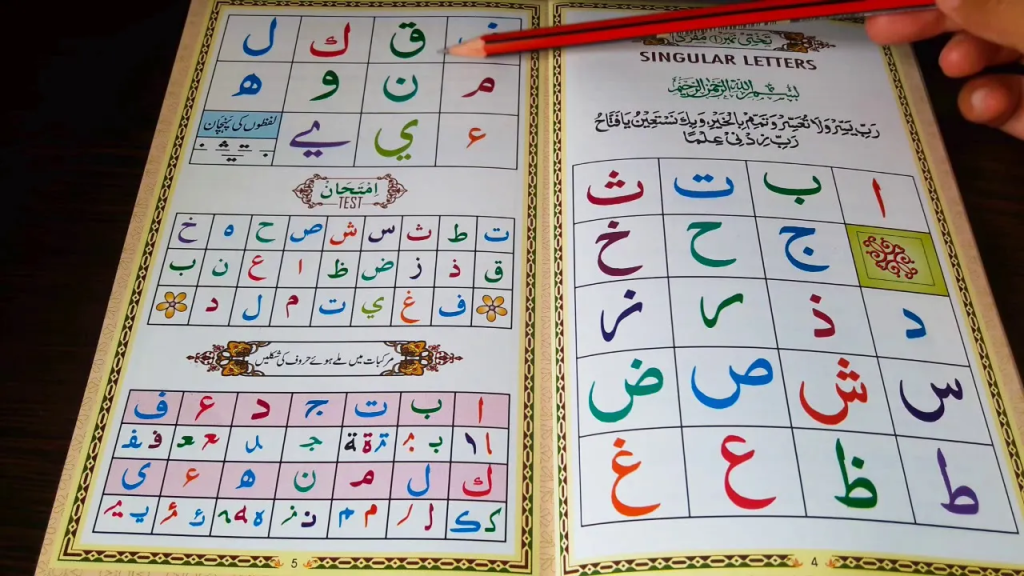
Noorani Qaida provides fundamental learning material for beginners so that they can read the Arabic script and learn how to read from the Holy Quran. The correct methodological learning of the Quran starts with this introductory book for those who do not speak Arabic like native speakers. Students learn Arabic letters along with sound pronunciation rules and Quranic reading patterns through sequential lessons presented in this booklet.
Benefits of Noorani Qaida
Because learning the Quran demands a proper reading style, it surpasses basic reading rules. The correct reading of the Quran demands stringent adherence to the rules, while Qaida remains the cornerstone of such learning methodology. Bypassing basic learning steps before diving into the Quran feels daunting, especially when you don’t understand Arabic as a Non-native speaker. The Arabic writing system with its dots, marks, and signs resembles an inscrutable puzzle. It systematically demystifies the Arabic writing system with each lesson.
An Overview of All the Chapters and Lessons
Noorani Qaida uses a step-by-step system where every lesson acts as a step to help you achieve fluent Quran reading skills. The primary structure of Qaida remains unaltered, but small differences occur between various published editions.
Fundamental Arabic Letters
Pathway commences by introducing the fundamental 29 letters of the Arabic language. Each single letter appears separately on the page with explicit markers and pronunciation instructions.
Harakat (Short Vowels)
Students progress to understand short vowels Fatha (a), Kasrah (i), together with Dammah (u). Minute marks completely alter letter sounds and maintain essential correctness for pronunciation.
Tanween (Double Vowels)
Similar to a pair of vocal marks which produce sound patterns of “an,” “in”, or “un.” Readers of the Quran often use these marks because they provide a slight nasal tone in their reading.
Madd Letters (Elongation)
Alif, Waw and Yaa show learners how to lengthen different vocal sounds through teaching. The oral extension known as Madd represents an essential element of Tajweed.
Sukoon and Jazm
These symbols indicate letters which should not produce a sound or remain silent during pronunciation. This tool demonstrates to the learner when they should stop their flow between letters or continue seamlessly.
Shaddah (Emphasis)
Shaddah appears when Arabic letters get a stronger sound or when they appear doubled. Shaddah serves to improve pronunciation richness while remaining vital for correct Quranic reading.
Reading Words
Beginner students who master fundamental skills will progress to reading enclosed letters that combine into full words and lead to brief Quranic passages.
Chapters build up from fundamental concepts while repeating essential ideas to create an effective spiral learning process. The process repeats itself in a rhythmic learning cycle: learn, practice, master, repeat.
Basic Arabic Alphabet
The Arabic script contains 29 letters, which begin with Alif (ا) and end with Yaa (ي). Every Arab letter produces a distinctive audio feature, with numerous letters lacking identical equivalents in English. Pronunciation holds critical importance in the Quranic learning process, and the Qaida places special focus on teaching it. A classic example is the letter ‘Ayn (ع), which creates deep throat-based sounds unrecognisable to English speakers.
An interesting fact about Arabic letters is that many appear the same but include different dot arrangements or numbers. For instance:
- Ba (ب), Ta (ت), and Tha (ث) have the same base shape but one, two, and three dots, respectively.
- Jeem (ج), Haa (ح), and Khaa (خ) also follow this pattern.
This similarity can be confusing, so Noorani Qaida emphasises visual recognition and phonetic distinction. Students are taught to recognise not just the shape but also the sound associated with each letter.
Harakat (Vowel Marks)
After knowing about the Arabic language, your next step will be understanding Harakat, or short vowel marks. In Arabic, vowels are not written as full letters (like A, E, I, O, U in English), but as small symbols placed above or below consonants.
There are three main Harakats:
- Fatha ( َ ) – A short “a” sound, placed above a letter.
- Example: بَ (ba)
- Example: بَ (ba)
- Kasrah ( ِ ) – A short “i” sound, placed below a letter.
- Example: بِ (bi)
- Example: بِ (bi)
- Dammah ( ُ ) – A short “u” sound, placed above a letter.
- Example: بُ (bu)
Tanween, Madd, and Sukoon
Here, Noorani Qaida makes the complex a simple matter. After learning the foundation of vowels, students discover special marks and sounds that enhance the spiritual power of their reading.
Tanween (ً ٍ ٌ)
The double vowels Tanween modify voice into nasal elimination:
- Fathatain = “an”
- ٍ Kasratain = “in”
- ٌ Dammatain = “un”
For example:
- بًا (ban)
- بٍ (bin)
- بٌ (bun)
A vital component of Quranic recitation and key to Arabic sentence building, Tanween operations. Well known for its tendency to appear at phrase ends, this mark enhances verse harmony.
Madd (ا و ي)
Madd describes vowel lengthening through three fundamental letters:
- Alif – elongates the “a” sound.
- Waw – elongates the “u” sound.
- Yaa – elongates the “i” sound.
For example:
- با (baa)
- بو (buu)
- بي (bii)
The rules of Tajweed demand Madd without exception; different Madd types require unique regulations. Qaida teaches fundamental Madd to students, allowing them to preserve the sound for two beats, thus developing their recitation timing.
Sukoon ( ْ )
The letter becomes silent when no vocalisation occurs. This mark appears as a tiny distance above letters to indicate a sound conjunction.
Example:
بْ (silent “b” sound as in “ab”)
The consonant cluster formation ability of the letter creates flowing and seamless pronunciation changes. Readers who master Sukoon can recognise stopping points and continuation signals, which mark essential skills for proper Tajweed execution.
By mastering the fundamentals of Tanween Madd and Sukoon, students advance towards authentic Quranic reading. They discover Arabic fulfils more aspects than just sounds because it incorporates timing together with pauses and flowing rhythm.
Conclusion
After all, this book goes beyond simple instruction; it represents your first milestone within the spiritual pilgrimage. It has changed millions of hearts because it turns Quran reading from a complicated process into an attainable and enjoyable experience. Due to its clear methodology and accurate phonetic comprehension, it enables Noorani Qaida to produce Quran readers who are exact and confident.

FAQs
1. How long does it take to complete Noorani Qaida?
The usual timeframe for learning Qaida ends up being three to half a year for someone who practices every day consistently. Children usually require longer periods for learning because their age and speed of learning influence the duration.
2. Can adults benefit from Noorani Qaida too?
This Qaida works perfectly for learners of all ages. This program has no age limitations and delivers effective learning for children and adults alike. Many adults who have recently embraced Islam begin their formal Quran studies through Qaida.
3. Is it necessary to learn Noorani Qaida before reading the Quran?
Non-Arabic speakers need Qaida for sure. This course guides students to master Quranic reading by teaching them vital skills in pronunciation and Tajweed, along with Arabic sentence organisation.
4. Are there digital versions or apps for Noorani Qaida?
Qaida exists in digital format and mobile applications, which users can utilise. The educational materials for Qaida come in various forms, including free applications and paid services, as well as YouTube videos and interactive PDFs. Students can benefit from flexible and accessible learning methods provided by these resources.
5. What should I do after finishing Noorani Qaida?
The subsequent step following Qaida completion requires beginning Tajweed-regular Quran reading. Expand your understanding by joining a Hifz course or by studying Tafsir, the interpretation of the Quran.